Although the Viceroy shares the Monarch's color scheme that is where the similarity end. Viceroys do not migrate. They overwinter as 1st or 2nd instar larvae, rolled up in a leaf of their host plant (willow or poplar).
The most distinctive difference is evident here in this comparison photo. The upper is a Monarch, the lower a Viceroy. You can see the black line across the Viceroy's post median hind wing.
Viceroys flit as they fly instead of the floating flap flap of a Monarch.
I hope you like the pics that I've chosen for you!
Unfortunately Pennsylvania doesn't have a state butterfly. I will share will you one of the butterflies from my state of Pennsylvania, the White Admiral Butterfly.
Identification: Upperside is black with broad white median bands on both wings; hindwing has a marginal row of blue dashes and a submarginal row of red dots. Underside is reddish-brown with white median bands as on the upperside. The other form of this butterfly, the Red Spotted Purple, hybridize where their ranges overlap, creating various intermediate forms which may be found in or near the overlap zone.
Wing Span: 2 1/4 - 4 inches (5.7 - 10.1 cm).
Life History: Males perch 3 feet or more above the ground on trees and tall bushes and rarely patrol for females. Eggs are laid singly on tips of host plant leaves; caterpillars eat leaves. Third-stage caterpillars hibernate.
Flight: Two broods from April-October.
Caterpillar Hosts: Leaves of many species of trees and shrubs including wild cherry (Prunus), aspen, poplar, cottonwood (Populus), oaks (Quercus), hawthorn (Crataegus), deerberry (Vaccinium stamineum), birch (Betula), willows (Salix), basswood (Tilia), and shadbush (Amelanchier).
Adult Food: Sap flows, rotting fruit, carrion, dung, and occasionally nectar from small white flowers including spiraea, privet, and viburnum. White Admirals also sip aphid honeydew.
Habitat: The White Admiral form is usually found in the north in deciduous broad-leaf or mixed evergreen forests dominated by aspen or birch. The Red-Spotted Purple form is usually found further south than the White Admiral, in deciduous or mixed forests, moist uplands, valley bottoms, and coastal plains.
Range: Red Spotted Purple is in Alaska and subarctic Canada southeast of the Rocky Mountains to central Texas; east to New England and central Florida. Isolated populations in Arizona, New Mexico, and west Texas south into Mexico. The White Admiral form usually occurs north of a line through north central New England, New York, Pennsylvania, Michigan, and Minnesota. The Red-spotted Purple form is usually found south of this line. Much hybridization occurs where these forms meet. The Red-spotted Purple is a mimic of the poisonous Pipevine Swallowtail (Battus philenor).
Here is an example of the Red Spotted Purple. This butterfly is not found in Pennsylvania.
Both of these butterflies are very beautiful. I hope you enjoyed.



Page 77 of CraftyMommaonaBUDGET's Comments
Back to CraftyMommaonaBUDGET's profile
EF Happy St Patrick's Day
{for the EF# Happy St Patricks Day swap} Enjoy!
BL ~ Butterflies From Our State or Country #1
Meet the Viceroy, Kentucky's state butterfly.
Although the Viceroy shares the Monarch's color scheme that is where the similarity end. Viceroys do not migrate. They overwinter as 1st or 2nd instar larvae, rolled up in a leaf of their host plant (willow or poplar).
The most distinctive difference is evident here in this comparison photo. The upper is a Monarch, the lower a Viceroy. You can see the black line across the Viceroy's post median hind wing.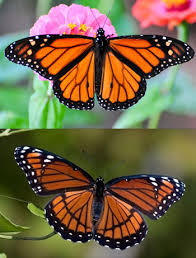
Viceroys flit as they fly instead of the floating flap flap of a Monarch.
I hope you enjoyed meeting the Viceroy.
BL ~ Butterflies From Our State or Country #1
I hope you like the pics that I've chosen for you!
Unfortunately Pennsylvania doesn't have a state butterfly. I will share will you one of the butterflies from my state of Pennsylvania, the White Admiral Butterfly.
Identification: Upperside is black with broad white median bands on both wings; hindwing has a marginal row of blue dashes and a submarginal row of red dots. Underside is reddish-brown with white median bands as on the upperside. The other form of this butterfly, the Red Spotted Purple, hybridize where their ranges overlap, creating various intermediate forms which may be found in or near the overlap zone.
Wing Span: 2 1/4 - 4 inches (5.7 - 10.1 cm).
Life History: Males perch 3 feet or more above the ground on trees and tall bushes and rarely patrol for females. Eggs are laid singly on tips of host plant leaves; caterpillars eat leaves. Third-stage caterpillars hibernate.
Flight: Two broods from April-October.
Caterpillar Hosts: Leaves of many species of trees and shrubs including wild cherry (Prunus), aspen, poplar, cottonwood (Populus), oaks (Quercus), hawthorn (Crataegus), deerberry (Vaccinium stamineum), birch (Betula), willows (Salix), basswood (Tilia), and shadbush (Amelanchier).
Adult Food: Sap flows, rotting fruit, carrion, dung, and occasionally nectar from small white flowers including spiraea, privet, and viburnum. White Admirals also sip aphid honeydew.
Habitat: The White Admiral form is usually found in the north in deciduous broad-leaf or mixed evergreen forests dominated by aspen or birch. The Red-Spotted Purple form is usually found further south than the White Admiral, in deciduous or mixed forests, moist uplands, valley bottoms, and coastal plains.
Range: Red Spotted Purple is in Alaska and subarctic Canada southeast of the Rocky Mountains to central Texas; east to New England and central Florida. Isolated populations in Arizona, New Mexico, and west Texas south into Mexico. The White Admiral form usually occurs north of a line through north central New England, New York, Pennsylvania, Michigan, and Minnesota. The Red-spotted Purple form is usually found south of this line. Much hybridization occurs where these forms meet. The Red-spotted Purple is a mimic of the poisonous Pipevine Swallowtail (Battus philenor).
Here is an example of the Red Spotted Purple. This butterfly is not found in Pennsylvania.
Both of these butterflies are very beautiful. I hope you enjoyed.
Love and blessings,
Your friend, Yvonne
Vanessa, please ignore my previous post. I was looking at the wrong swap. Yes, you are my partner.
Love and blessings,
Your friend, Yvonne
Thank you for sharing, but you are not my partner!
Love and blessings,
Your friend, Yvonne
St Patrick’s Day Hope you enjoy these images and may the luck of the Irish be with you


Welcome to Butterfly lovers! It's great to have you here!
Love and blessings,
Your friend, Yvonne